Case Study: Workplace Assessment for Growing Engineering Firm
Sector: Engineering
Company Size: 70 employees
Location: Greater Manchester
Project Type: Pre-RIBA Stage 0 Workplace Diagnostic Assessment
Duration: 5 weeks
The Challenge
This specialist engineering company had grown rapidly, nearly doubling their workforce in just two years. But the physical workspace hadn't kept pace - the office simply was no longer fit for purpose.
The core issue was a desk-heavy model that didn't support activity-based working. The environment lacked variety in work settings, forcing formal meetings as the primary collaboration mechanism. Leadership recognised a telling pattern: people complained about 'too many meetings' whilst simultaneously struggling to collaborate effectively. The issue wasn't just meetings themselves - it was that the environment offered no alternative.
With a lease renewal decision on the horizon, they needed support in understanding the root causes of their workplace challenges and developing a space strategy - whether that meant renovation, relocation, or a phased approach.
The Approach
Rather than jumping to design solutions, we began with a focused diagnostic to understand the current situation and identify priorities for further investigation.
Research Foundation
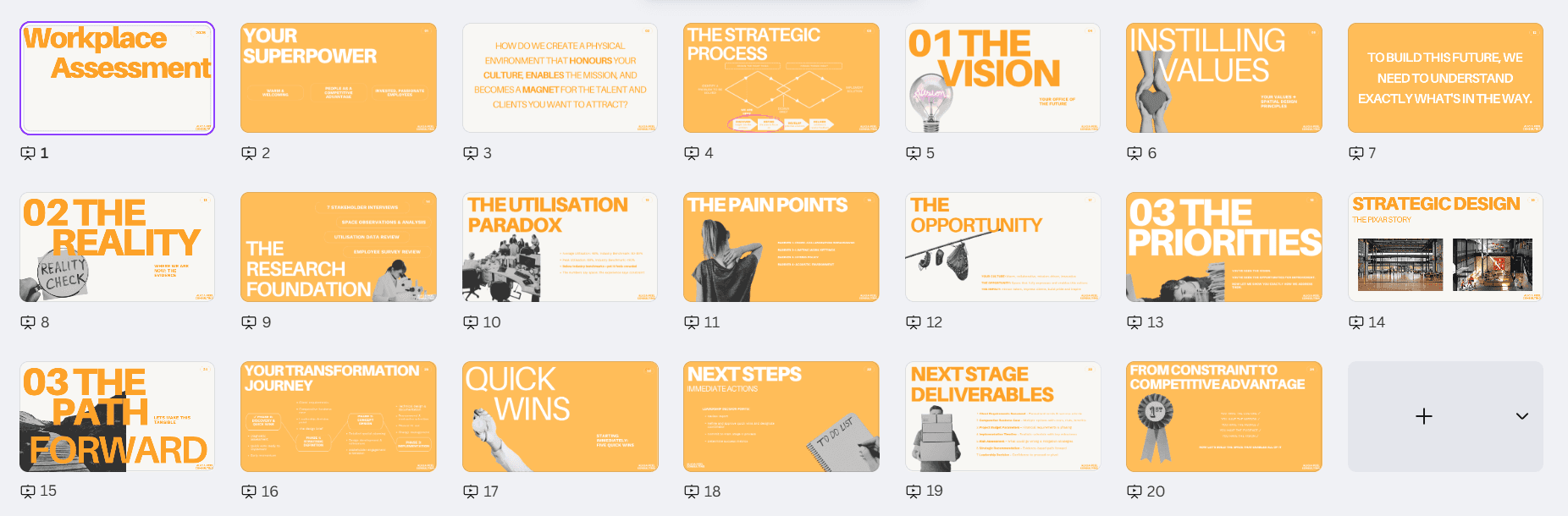
Seven leadership interviews across departments - including remote team members to capture diverse senior perspectives
Existing data review including available utilisation information and prior employee survey results
Independent space observations assessing visual and acoustic environment, spatial character, and brand expression
This initial assessment was designed to surface key themes and inform whether deeper investigation was warranted. It provided sufficient insight to identify priorities and quick wins, whilst highlighting areas where additional data collection - such as detailed utilisation studies or broader employee input - would strengthen decision-making for larger investments.
Key Findings
Despite strong employee engagement and clear values alignment, the assessment identified five critical friction points constraining performance:
Critical Friction Points
Cross-collaboration breakdown: Cross-functional friction between teams compounded by ineffective meeting culture, spatial separation, and limited effective collaboration settings
Limiting work settings: Insufficient variety of work settings, paired with minimal circulation space and visual clutter risking psychological stress and cognitive overload
Hybrid working policy: Guidance encouraging office attendance for collaboration days and home working for focus days may be compounding challenges - the physical environment lacks the collaboration settings needed to make office days worthwhile
Acoustic environment: Noise preventing focus work and professional calls, no phone booths or private spaces
Brand and culture disconnect: Environment failing to communicate the organisation's engineering excellence and strong culture through spatial design
Deliverables
The client received a comprehensive deliverable package designed to inform confident decision-making:
34-page diagnostic assessment report with evidence-based findings, analysis, and strategic recommendations
Quick wins implementation roadmap identifying improvements achievable within 0-3 months at minimal investment
RIBA Stage 0 preparation guidance including recommended data collection activities and baseline metrics to establish before interventions
Leadership presentation summarising findings and facilitating strategic discussion
Strategic options framework outlining pathways for stay/renovate/relocate decisions
Outcomes & Impact
The assessment enabled the client to:
Understand root causes: Leadership gained initial clarity on which challenges were symptoms versus underlying issues, providing a foundation for further investigation
Identify immediate improvements: Quick wins roadmap provided actionable steps to address pressing issues without waiting for larger transformation
Inform strategic decisions: Strategic design priorities to inform design decisions, plus framework for evaluating renovation versus relocation options
Establish measurement foundation: Initial ideas for success measurements to ensure any future interventions can demonstrate measurable impact
Project Status: This project is currently pending progression to RIBA Stage 0 and quick win implementation. Outcomes will be updated as the client acts on recommendations.
Client Testimonial
“After seeing some LinkedIn posts from Alicia, which looked differently at the problems within the workplace, I immediately knew I had to make contact. Where others focus on the actual space; moving desks, painting colours, etc, or with the fixed mindset that employees should be in the office, Alicia focuses on how you embed your culture in the workplace environment, what is the value of encouraging people into the office, why do they want to come in and how to use the space to encourage collaboration.
In a short space of time, she has created an in-depth report that truly understands our organisation and can help add to our culture. When I initially spoke with her, I tried to lower my excitement at the 'art of the possible' because the initial assessment was to be done in only 5 weeks. The resulting report has exceeded our expectations and will support a significant improvement in the working environment for our teams.
We have benefited from an independent critique of our policies and working practices, done in a way which doesn't criticise but enhances what we are doing. If you have issues with your teams collaborating, if you have issues with people wanting to come into the offices, if you want to consider ways of making your meetings add value, if you are looking to create an innovative environment or if you just have space issues within the workplace, then I have no hesitation recommending that you contact Alicia to undertake a Strategic Workplace Assessment on your organisation."
What they were hoping to get:
"An initial assessment of key areas across the business to focus on and improve. A change in our way of thinking and an independent critique of our current way of working."
How the reality compared:
"The result was better than expected, including data to signpost actions and much more depth than I thought from only a 5 week trial."
Why This Approach Works
Many workplace projects fail to maximise return on investment because they jump to design solutions before getting to the root of workplace challenges and identifying strategic opportunities. Without understanding the underlying issues, organisations often find themselves forced to reinvest in the workplace not long after. This diagnostic-first approach ensures organisations understand their current situation before committing to significant investment.
By combining existing data with leadership perspectives and independent observation, the assessment surfaces priority issues and identifies where deeper investigation would add value. This staged approach manages risk—allowing organisations to act on clear findings immediately whilst building the evidence base for larger decisions.
Is Your Workplace Working?
If you're questioning whether your office environment supports your culture and business objectives, a diagnostic assessment provides the evidence you need to make confident decisions - whether that's implementing quick wins, planning major transformation, or validating that your current approach is working.
Want to hear directly from this client? They're happy to speak with prospective clients about their experience with this project.